🇺🇦 Ця сторінка українською
What would 2035 look like if AI had gone well?
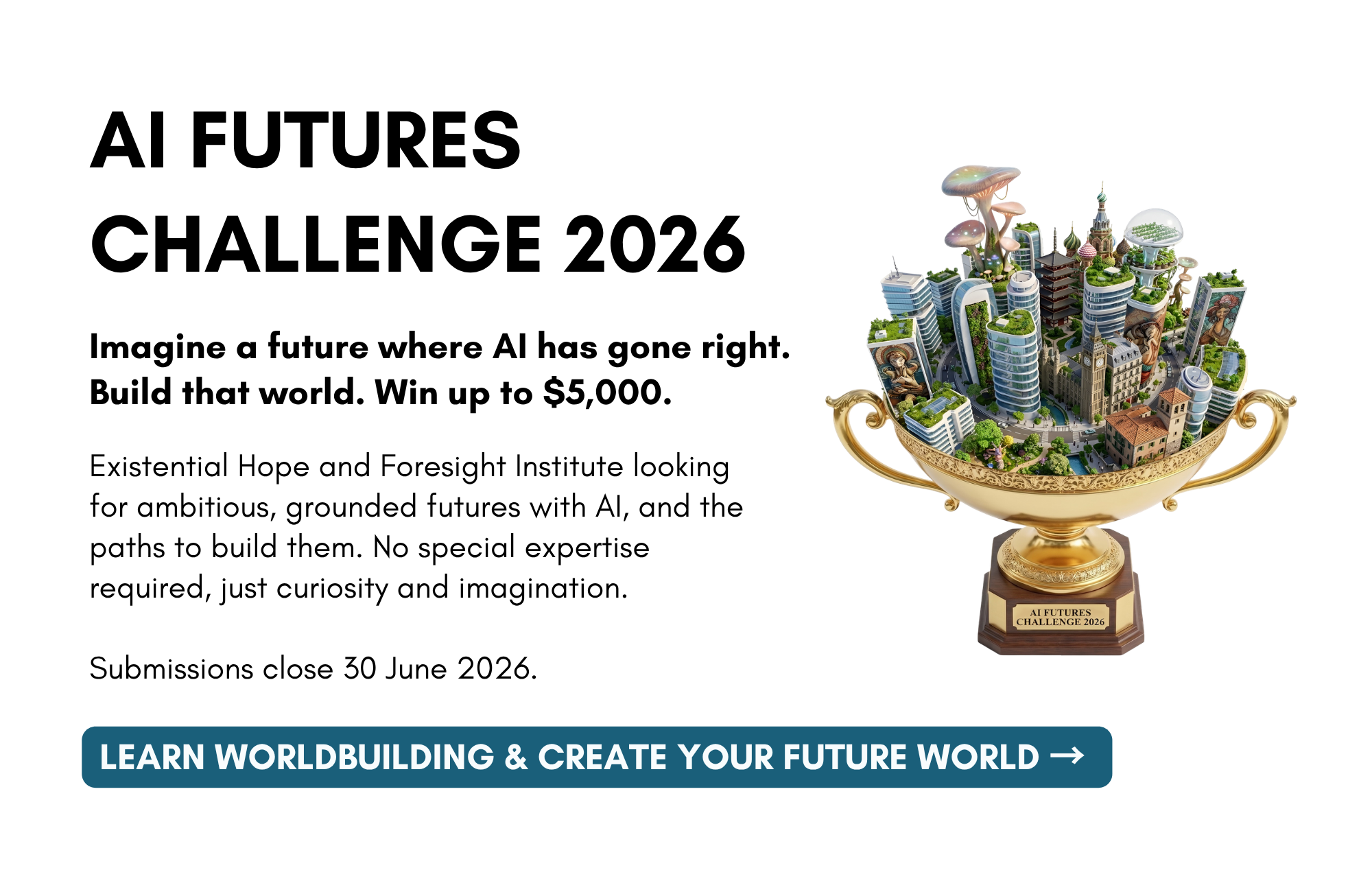
The AI Futures Challenge 2026 teaches worldbuilding, offers free foresight tools to explore AI futures, and gives awards for the best visions of 2035. Submissions close on 30 June 2026.
What is worldbuilding?
Worldbuilding means creating a detailed, believable picture of a possible future. You describe how people live, how technology works, how institutions are organised, and what problems remain unsolved.
It is not a creative writing. Researchers, professional futurists, designers, businesses, governments, and organisations use worldbuilding to think through complex futures before they arrive, stress-test strategies, communicate complex ideas to wide audiences, and build shared understanding across different groups. When you build a coherent future in detail, you start to see what steps are needed to get there and what obstacles stand in the way.
This is closely connected to strategic foresight that is a practice of preparing for multiple possible futures rather than trying to predict just one.
What is the challenge?
The AI Futures Challenge 2026 is run by Existential Hope, a nonprofit initiative of the Foresight Institute. It asks participants to build a vision of 2035 where AI has developed in a way that is genuinely good for people and society.
The total prize pool is $10,000. The top prize of $5,000 goes to the best overall world. Five further prizes of $1,000 each go to the best visuals, best transformative technology, most inspiring vision, best transformed sector, and best institution.
All submissions are published in the public World Gallery, where you can browse entries from participants around the world.
Deadline: 30 June 2026
What will you learn?
Before submitting, you complete a free 1.5-hour course on Udemy: Worldbuilding Hopeful Futures with AI. No prior knowledge is needed.
The course covers how to think about the future in a structured way, how technology and society shape each other, how emerging technologies could change daily life, and the tradeoffs of an AI-driven world. It follows the same step-by-step process used in foresight practice.
Guest lectures come from researchers and practitioners on AI governance, climate, jobs, biotech, and the psychology of hope.
Speakers include Anthony Aguirre on whether AI will replace us or help us thrive, Helen Toner on who gets to decide AI’s future, Hannah Ritchie on climate tech and AI, Anton Korinek on jobs in an AI future, and Ada Palmer on storytelling tools for worldbuilding. Each lecture brings a different perspective on what an AI-enabled future could look like and what questions we should be asking now.
The course website also includes a free Toolbox with vocabulary guides, scenario-planning methods, and reading lists you can use well beyond the challenge itself.
How to enter
Step 1. Take the free course
Complete Worldbuilding Hopeful Futures with AI on Udemy. It is self-paced and takes about 1.5 hours.
Step 2. Build your future world
Use the course assignments and the Toolbox to develop your submission. AI tools are allowed. You can enter alone or as a team.
Step 3. Submit by 30 June
Fill in the submission form, answer the open-ended questions, and upload any visuals you have created. Winners are announced in mid-July 2026.
What makes a strong entry?
The judges look for four things:
- imagination (does your world show something genuinely new?),
- grounded ambition (is it big but reachable from today?),
- coherence (do the different parts fit together logically?),
- hopefulness (is this a future worth building, without being naive?).
Browse the World Gallery to see what others have built.
Who can enter?
Anyone aged 16 or older, from any country. No expertise needed. Under-18s need a parent or guardian’s permission. You keep full rights to your work.
This post is also available in uk.