
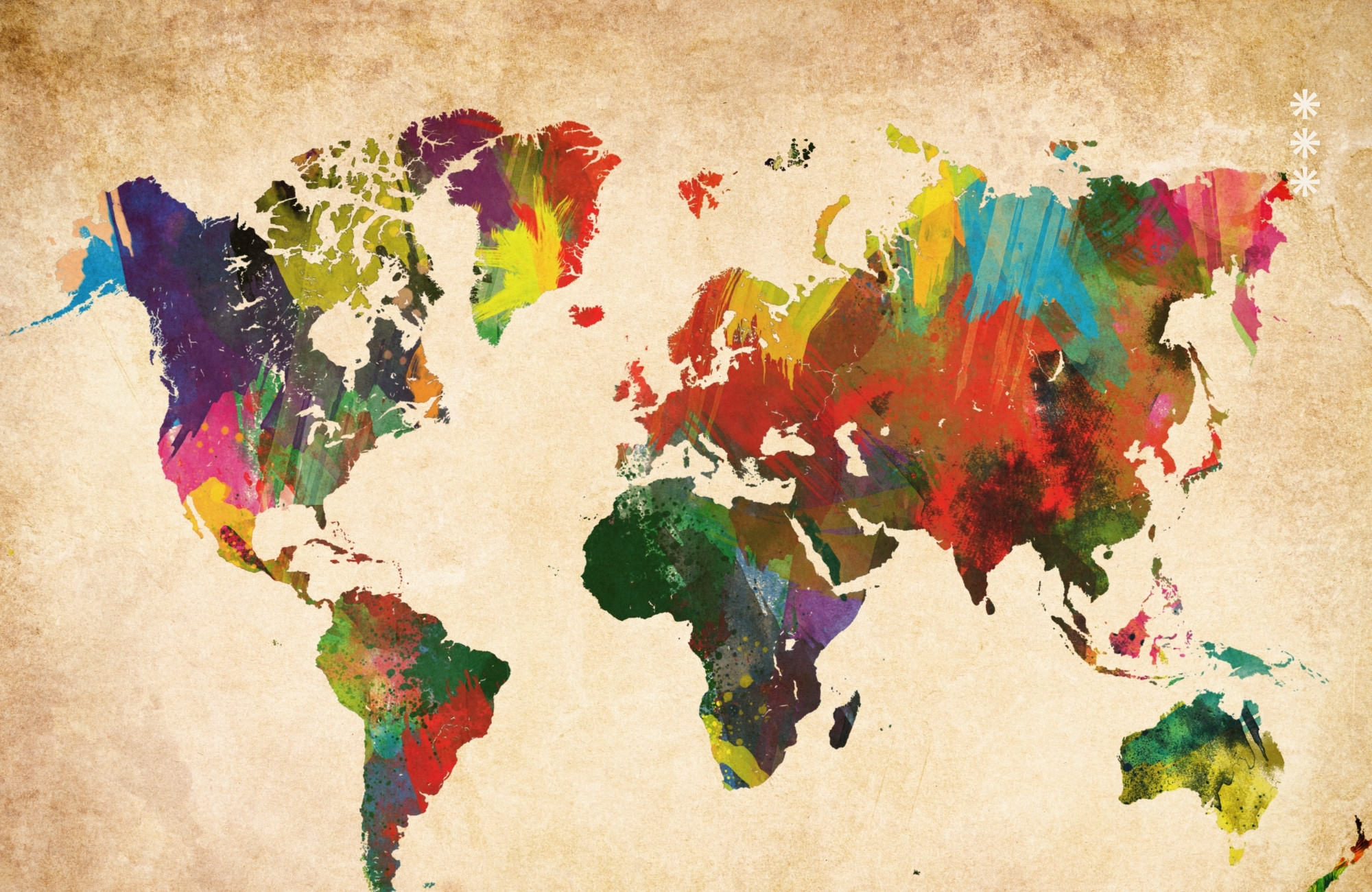
This is a living map of stories and fiction that speak to futures — not just science fiction set in tomorrow, but also stories that grapple with anticipation, foresight, change and transformation.
Some of these books imagine distant civilizations or dystopian regimes. Others are set firmly in the past or present but ask futures questions: How do societies recognize emerging crises? How do individuals build agency when the systems around them collapse? What happens when a culture suppresses its own capacity to imagine what comes next?
The map is organized by region and subregion, with countries listed alphabetically in brackets. As we discover new books, we add them. The blank spaces are invitations for contribution.
Contents: Africa – Asia – Europe – North America – Central America – South America – Australia – Melanesia – Micronesia – Polynesia – Arctic
Africa
Northern Africa
(Algeria, Egypt, Libya, Morocco, Sudan, Tunisia, Western Sahara)
Algeria
- Albert Camus (Algerian-born French writer) — The Plague (Goodreads 4.02). The story explores how a city recognizes, denies, and collectively responds to an emerging epidemic — a study in preparedness, systemic failure, and the will to resist.
Western Africa
(Benin, Burkina Faso, Cape Verde, Côte d’Ivoire, Gambia, Ghana, Guinea, Guinea-Bissau, Liberia, Mali, Mauritania, Niger, Nigeria, Senegal, Sierra Leone, Togo)
Central Africa
(Cameroon, Central African Republic, Chad, Congo, Congo DRC, Equatorial Guinea, Gabon, São Tomé and Príncipe)
Eastern Africa
(Burundi, Comoros, Djibouti, Eritrea, Ethiopia, Kenya, Madagascar, Mauritius, Mayotte, Réunion, Rwanda, Seychelles, Somalia, South Sudan, Tanzania, Uganda)
Southern Africa
(Angola, Botswana, Eswatini, Lesotho, Malawi, Mozambique, Namibia, South Africa, Zambia, Zimbabwe)
South Africa
- Deji Bryce Olukotun (South African & the USA) — Nigerians in Space (Goodreads 3.45). The book tells the story of a Nigerian lunar geologist recruited into a secret brain-gain program, imagining African agency in space exploration and the futures it could unlock. Nigerians in Space #1.
- Deji Bryce Olukotun (South African & the USA) — After the Flare (Goodreads 3.55). The story explores a post-solar-flare world where Nigeria emerges as a technological leader, launching a harrowing rescue mission into space while ancient and futuristic forces collide. Nigerians in Space #2.
- Bryce Courtenay (South African & Australian) — The Power of One (Goodreads 4.36). The author narrates a boy’s journey through apartheid-era South Africa, deliberately building a vision for his own future against a system designed to deny him one through individual agency.
Asia
Eastern Asia
(China, Hong Kong, Japan, Korea DPR, Korea Republic, Macao, Mongolia, Taiwan, Tibet)
China
- Liu Cixin — The Three-Body Problem (Goodreads 4.08). The story explores humanity’s first contact with an alien civilization, forcing long-term strategic thinking under conditions of radical uncertainty and existential threat.
Japan
- Kazuo Ishiguro — Klara and the Sun (Goodreads 3.82). The story explores the world through the eyes of an Artificial Friend — a solar-powered android companion — raising questions about love, consciousness, and what it means to be replaceable in a near-future of genetic enhancement.
Korea, Republic of
- Yun Ko-eun — The Disaster Tourist (Goodreads 3.49). The book tells the story of a travel agency employee who discovers her company is engineering catastrophes to sustain its disaster tourism packages — a dark satire on the corporate commodification of crisis.
South-Eastern Asia
(Brunei, Cambodia, Indonesia, Laos, Malaysia, Myanmar, Philippines, Singapore, Thailand, Timor-Leste, Viet Nam)
Thailand
- Pitchaya Sudbanthad — Bangkok Wakes to Rain (Goodreads 3.40). The author narrates multiple lives across two centuries of Bangkok’s history, culminating in a flooded future city where teenagers row tourists past drowned landmarks they themselves do not remember.
Indonesia
- Eka Kurniawan — Beauty Is a Wound (Goodreads 3.74). The story explores four generations of an Indonesian family through magical realism, tracing how colonial violence and unprocessed history shape the futures that people inherit.
Southern Asia
(Afghanistan, Bangladesh, Bhutan, India, Maldives, Nepal, Pakistan, Sri Lanka)
Western Asia
(Armenia, Azerbaijan, Bahrain, Cyprus, Georgia, Iran, Iraq, Israel, Jordan, Kuwait, Lebanon, Oman, Palestine, Qatar, Saudi Arabia, Syria, Turkey, UAE, Yemen)
Iran
- Sadegh Hedayat — The Blind Owl (Goodreads 4.00). The author narrates the hallucinatory confession of a mind trapped in loops, unable to break into a different future — a portrait of futures consciousness collapsing entirely.
- Omar Khayyam — Rubaiyat (Goodreads 4.24). The poet meditates on impermanence, time, and the urgency of the present moment — futures exploration in its oldest form, questioning whether any certainty lies beyond today.
Iraq
- Ahmed Saadawi — Frankenstein in Baghdad (Goodreads 3.58). The story explores a creature assembled from the body parts of bomb victims in occupied Baghdad, seeking vengeance on behalf of the dead — what emerges when a society’s future is built from its own destruction.
United Arab Emirates
- Maha Gargash — The Sand Fish (Goodreads 3.52). The book tells the story of a young Bedouin woman navigating the rigid structures of 1950s Gulf society — individual agency and the reimagining of one’s future within a world undergoing rapid transformation.
Central Asia
(Kazakhstan, Kyrgyzstan, Tajikistan, Turkmenistan, Uzbekistan)
Europe
Eastern Europe
(Belarus, Bulgaria, Czech Republic, Estonia, Hungary, Latvia, Lithuania, Moldova, Poland, Romania, Slovakia, Ukraine)
Czech Republic
- Karel Čapek — RUR & War with the Newts (Goodreads 3.93). The author who invented the word “robot” explores humanity’s compulsion to create and exploit other beings — from manufactured workers to enslaved salamanders — and the civilizational collapse that follows.
Poland
- Stanisław Lem — Solaris (Goodreads 3.98). The book tells the story of a scientist confronting a planetary intelligence that defies all human frameworks of understanding — the limits of foresight when the future is truly alien.
Ukraine
- Oksana Zabuzhko — The Museum of Abandoned Secrets (Goodreads 3.91). The story explores how suppressed histories resurface across generations as signals that reshape identity and drive future change — the past as unfinished business that demands a different future.
- Volodymyr Vynnychenko — Soniachna Mashyna (The Solar Machine). The author narrates a society transformed by a revolutionary energy technology, exploring how utopian invention collides with human nature — a classic of Ukrainian speculative fiction.
Northern Europe
(Åland Islands, Denmark, Faroe Islands, Finland, Iceland, Norway, Sweden)
Southern Europe
(Albania, Andorra, Bosnia and Herzegovina, Croatia, Gibraltar, Greece, Holy See, Italy, Kosovo, Malta, Montenegro, North Macedonia, San Marino, Serbia, Slovenia, Spain)
Portugal
- José Saramago — Blindness (Goodreads 4.12). The book tells the story of a city struck by an epidemic of white blindness, exploring how quickly civilization unravels and what fragile human bonds hold when all systems collapse.
Western Europe
(Austria, Belgium, France, Germany, Ireland, Liechtenstein, Luxembourg, Monaco, Netherlands, Switzerland, United Kingdom)
United Kingdom
- George Orwell — 1984 (Goodreads 4.19). The author narrates life in a surveillance state engineered to close off all alternative futures — a society where independent thought itself has become impossible.
- George Orwell — Animal Farm (Goodreads 3.98). The book tells the story of a revolution that arcs from liberation to replication of the old order — how visions of a better future get co-opted by those who seize power.
- H.G. Wells — The War of the Worlds (Goodreads 3.83). The story explores what happens when a technologically superior civilization arrives uninvited — the future as invasion, and human vulnerability laid bare.
- Olaf Stapledon — Star Maker (Goodreads 4.08). The author narrates the entire history of the cosmos from first consciousness to final extinction — the most ambitious act of futures imagination in all of literature.
North America
Northern North America
(Canada, United States)
Canada
- Margaret Atwood — Oryx and Crake (Goodreads 4.00). The story explores a biotech dystopia built from corporate hubris and genetic engineering — the future as an engineered catastrophe with no way back.
- Margaret Atwood — The Handmaid’s Tale (Goodreads 4.15). The book tells the story of a theocratic regime that has overthrown American democracy, exploring how quickly rights can be dismantled and a society reshaped.
- Margaret Atwood — The Year of the Flood (Goodreads 3.87). The story explores grassroots survival in a collapsing world through the eyes of an eco-religious community — alternative ways of living as futures practice.
United States
- Marge Piercy — Woman at the Edge of Time (Goodreads 3.88). The book tells the story of a woman in a psychiatric ward who travels between a utopian and a dystopian future — showing how present-day choices determine which world comes into being.
- Octavia E. Butler — Parable of the Sower (Goodreads 4.19). The author narrates a young woman’s journey through a collapsing America as she builds a new belief system from scratch — futures consciousness as survival strategy.
- Jeff VanderMeer — Annihilation (Goodreads 3.67). The story explores a mysterious zone where nature has become an unknowable transforming force — a future beyond human control, comprehension, or reversal.
- Kim Stanley Robinson — The Ministry for the Future (Goodreads 3.80). The book tells the story of a near-future international body tasked with representing the interests of future generations — futures as policy, negotiation, and institutional design.
- Kim Stanley Robinson — Antarctica (Goodreads 3.51). The story explores near-future geopolitics on the last unclaimed continent, where competing visions for a shared future collide with environmental fragility.
- Ray Bradbury — Fahrenheit 451 (Goodreads 3.97). The author narrates a society that burns its own books and memory — what happens when a culture severs itself from the tools of reflection and foresight.
- Dan Simmons — Hyperion (Goodreads 4.23). The book tells the story of seven pilgrims converging on a mysterious future event, each carrying a tale that weaves together time, prophecy, and the weight of anticipation.
- Clifford D. Simak — City (Goodreads 3.95). The story explores humanity’s far-future successors — intelligent dogs and robots — inheriting a world after the slow, voluntary extinction of human civilization.
Southern North America
(Bermuda)
Central America
(Belize, Costa Rica, El Salvador, Guatemala, Honduras, Mexico, Nicaragua, Panama)
Mexico
- Yuri Herrera — Signs Preceding the End of the World (Goodreads 3.86). The book tells the story of a young woman crossing into another country and another reality — a mythic journey through anticipatory signals, liminality, and transformation.Peru
- Mario Vargas Llosa — The Feast of the Goat (Goodreads 4.15). The story explores the final days of a dictatorship through individuals deciding whether to resist or comply — every character making a bet on what comes next.
Caribbean
(Anguilla, Antigua and Barbuda, Aruba, Bahamas, Barbados, Cayman Islands, Cuba, Curaçao, Dominica, Dominican Republic, Grenada, Guadeloupe, Haiti, Jamaica, Martinique, Montserrat, Netherlands Antilles, Puerto Rico, Saint Kitts and Nevis, Saint Lucia, Saint Vincent and the Grenadines, Sint Maarten, Trinidad and Tobago, Turks and Caicos Islands, Virgin Islands British, Virgin Islands U.S.)
South America
Western South America
(Bolivia, Chile, Colombia, Ecuador, Peru, Venezuela)
Peru
- Mario Vargas Llosa — The Feast of the Goat (Goodreads 4.15). The story explores the final days of a dictatorship through individuals deciding whether to resist or comply — every character making a bet on what comes next.
Eastern South America
(Argentina, Brazil, Falkland Islands, French Guiana, Guyana, Paraguay, Suriname, Uruguay)
Australia
(Australia, Christmas Island, Cocos Islands)
Australia
- Alexis Wright — The Swan Book (Goodreads 3.46). The author narrates an Indigenous girl’s journey through a climate-ravaged future Australia — speculative fiction rooted in deep cultural time and the collision of ancient knowledge with catastrophe.
Melanesia
(Fiji, New Caledonia, Papua New Guinea, Solomon Islands, Vanuatu)
Micronesia
(Guam, Kiribati, Marshall Islands, Micronesia, Nauru, Northern Mariana Islands, Palau)
Polynesia
(American Samoa, Cook Islands, French Polynesia, New Zealand, Niue, Pitcairn, Samoa, Tokelau, Tonga, Tuvalu, Wallis and Futuna)
New Zealand
- Keri Hulme — The Bone People (Goodreads 3.63). The story explores three broken people reconstructing their futures from the wreckage of personal and cultural collapse — what do you rebuild when everything has fallen apart.
Arctic
(Greenland)
Antarctica
(Antarctica, French Southern Territories)